
Extended Producer Responsibility Packaging: What Ecommerce Brands Need to Know

Data subject to change as legislation develops. Check state legislation and Producer Responsibility Organizations (PROs) for the most up-to-date information. This map reflects legislative research compiled from public sources and is provided for informational purposes only.
What is Extended Producer Responsibility (EPR)?
For years, digital-native fashion and footwear brands focused on two primary metrics: customer acquisition cost and lifetime value. But a massive regulatory shift is rewriting the rules of ecommerce profitability, state by state. Extended Producer Responsibility (EPR) has officially made the jump from packaging to the products themselves.
From California’s pioneering 2026 SB 707 textile recovery mandates to the EU’s sweeping Waste Framework Directive deadlines, “polluter pays” legislation is a global concern.
This article covers the latest Extended Producer Responsibility news. It explains key timelines and requirements and shows how right-sized packaging automation fits in.
EPR is a growing set of state-level regulations. These rules require brands to fund recycling and waste-management programs. While these programs encourage eco-friendly product design, they can raise fees. Fees may increase based on packaging volume, material type, and recyclability.
Extended Producer Responsibility (EPR) laws for packaging are growing across the U.S. These laws add material fees, reporting rules, and sustainability requirements. They will reshape how brands design, package, and ship their products.
According to the U.S. Environmental Protection Agency, the producer is responsible for the brand on the packaging. A “producer” is a company that sells packaged products in a state with EPR regulations. EPR transfers the cost and duty of managing packaging waste from cities to producers that put packaging on the market.
Why does EPR Matter for Apparel and Footwear Brands?
If your brand ships apparel or footwear directly to consumers, you are not just responsible for a great unboxing. You have other responsibilities, too. You are now legally and financially responsible for where that product ends up at the end of its lifecycle.
For high-volume shippers, “good enough” order packaging is now subject to measurable financial penalties. Oversized shipments may mean higher DIM (dimensional weight) surcharges. Consumers are increasingly vocal about packaging waste. And now EPR Legislation may apply additional charges.
For apparel and footwear companies, it’s time to rethink readiness for EPR and ensure the right strategies are in place. Right-sizing tactics that support EPR compliance for large-scale distribution are critical for success in today’s market.
What States Have EPR Requirements?
There are currently seven states with enacted frameworks:
- Oregon
- Colorado
- Maine
- California (Via SB 54, the most expansive packaging law in the U.S.)
- Minnesota
- Maryland
- Washington
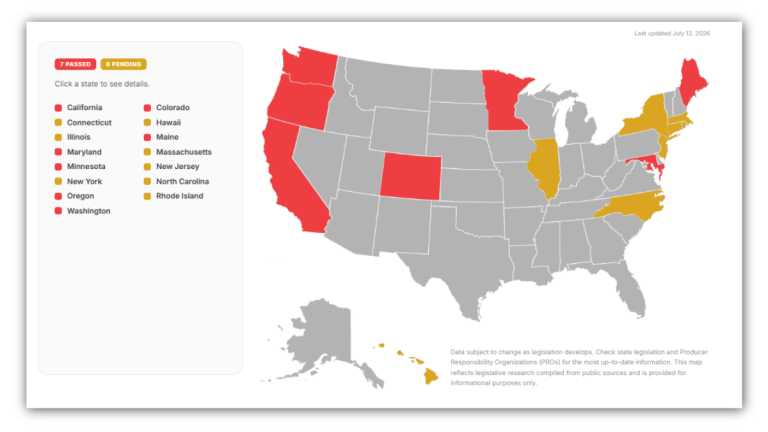
Specifically for textiles and apparel, California is currently leading the charge with its SB 707 textile recovery program. States like New York and Massachusetts have actively debated similar textile-specific frameworks.
The Product Stewardship Institute is a non-profit that actively maps state-level EPR laws across multiple product categories. You can also see our interactive EPR legislation map for more information.
Built for Different Operational Needs
Tension’s ecommerce packaging solutions are designed to support a wide range of fulfillment models. Whether your facility relies on high-velocity automated lines, semi-manual order packing, or is actively scaling up to meet peak seasonal volume, Tension creates workflows tailored to your facility footprint, SKU mix, staffing model, and long-term compliance goals.
For apparel and footwear brands, order sizes change dynamically—from a single folded t-shirt to multi-item orders with bulky boots or outerwear. Systems like the fitPACK500™ adapt in real time using 3D scanning technology to right-size every order on the fly. This compact, high-efficiency footprint reduces heavy conveyor infrastructure, eliminates secondary void-fill, and ensures flexible packaging materials (including high-PCR films) integrate seamlessly into your existing shipping setup.
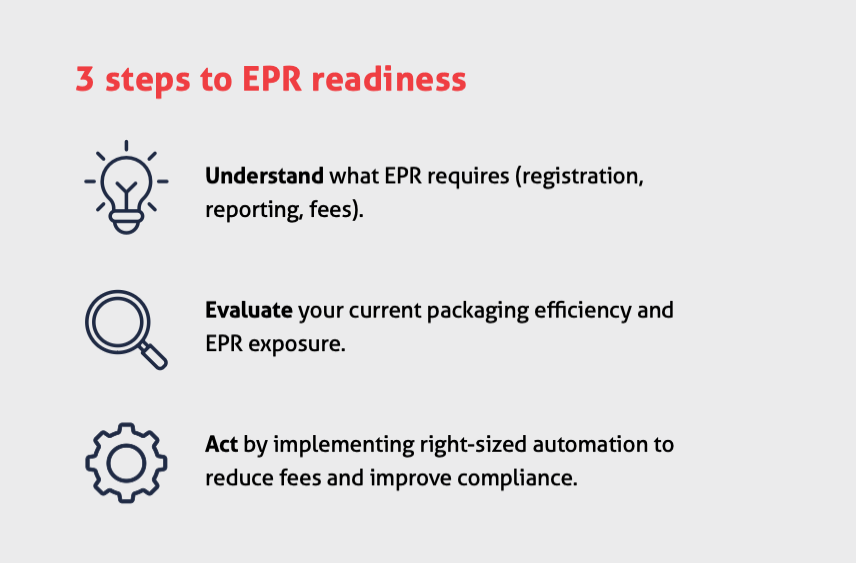
How to Prepare for EPR
What is Right-Size Packaging Important?
Right-sized packaging is designed to customize packaging to fits the exact volume of a product. Under Extended Producer Responsibility (EPR) frameworks, right-sized packaging plays a significant role in mitigating surging compliance costs.
You Pay by Weight and Material Volume
Nearly all state and global packaging EPR frameworks function as a “polluter pays” program where your annual or quarterly invoice is determined by a strict formula: Total Weight of Material Shipped × Material Fee Rate.
- The Oversized Penalty: If you ship a pair of sandals in a box that is 40% larger than necessary, you are paying for the excess corrugated cardboard weight.
- The Void-Fill Trap: To prevent the product from rattling around, fulfillment teams stack the box with plastic film air pillows, crumpled paper, or foam peanuts. Under EPR, you are legally responsible for the end-of-life processing of that void-fill material too. Right-sizing completely eliminates the weight and cost of void-fill.
Avoiding Eco-Modulation Multipliers
States like California (SB 54) and Oregon use eco-modulation to incentivize sustainable choices. If your packaging includes mixed-material components—like a cardboard box lined with plastic bubble wrap that cannot be separated by the consumer—it is categorized as “hard to recycle.”
- These materials face steep financial penalties or multiplier fees.
- Right-sized, single-material packaging (like a 100% recyclable paper mailer tailored to a shirt’s dimensions) secures the lowest possible tier of EPR fee structures.
The "Unfilled Space" Regulatory Targets
Modern EPR legislation is increasingly looking at structural efficiency, not just material types. If your box contains more than 40% empty space or void-fill, you could face direct regulatory penalties on top of your standard material fees.
The Bottom-Line Reality
Right-sizing creates a compounding financial benefit for ecommerce operations:
Smaller, Right-Sized Box = Lower Product Weight -> Drastically Reduced EPR Fees
As a secondary benefit completely outside of EPR compliance, right-sizing also shrinks your dim-weight (dimensional weight) shipping costs with carriers like FedEx, UPS, and DHL, multiplying your cost savings across both logistics and legal compliance.
Right-Sized Packaging Automation
Tension Packaging & Automation leads with flagship equipment like the fitPACK500™ (pictured above). Their right-sized packaging automation systems fix key operational problems. They also reduce financial pain points often caused by EPR regulations.
When used in an ecommerce apparel and footwear fulfillment workflow, Tension’s systems change packaging. They turn it from a legal risk into a controlled asset.
Using oversized polybags or boxes dramatically spikes your quarterly compliance invoice. The fitPACK500™ uses advanced 3D scanning to measure each item or order group’s length, width, and height. It dynamically cuts and seals the package to match those exact dimensions. By removing extra tail and edge material, the system reduces weight per SKU. This directly lowers your baseline EPR material fees.
Because Tension’s systems create a perfectly tight, custom-fit enclosure around the apparel or footwear, the need for secondary void-fill is completely eliminated. The package is dynamically deflated and sealed in one seamless process. This strips out extra components that would otherwise require meticulous tracking and draw steep eco-modulated penalty multipliers.
Systems like the fitPACK500™ combine the whole packaging process into one automated stream. It bags items, removes air, and applies the shipping label at the same time. Your compliance team receives clean, predictable data for quarterly reporting.
Is Your Fulfillment Line Ready for Upcoming EPR Deadlines?
Between shifting state laws and strict empty-space ratios, you can’t afford the operational cost of ignorance and inaction. Learn how to use advanced 3D scanning and automated bagging to reduce dimensional weight shipping costs and EPR liability.
Download our free EPR Readiness Guide for Packaging Apparel and Footwear to future-proof your brand today.
NOTE: Data subject to change as legislation develops. Check state legislation and Producer Responsibility Organizations (PROs) for the most up-to-date information. This article reflects legislative research compiled from public sources and is provided for informational purposes only.
- Category: Automation, Blog, eCommerce, Packaging
- Tag: eCommerce automation, EPR, Right-sized Packaging